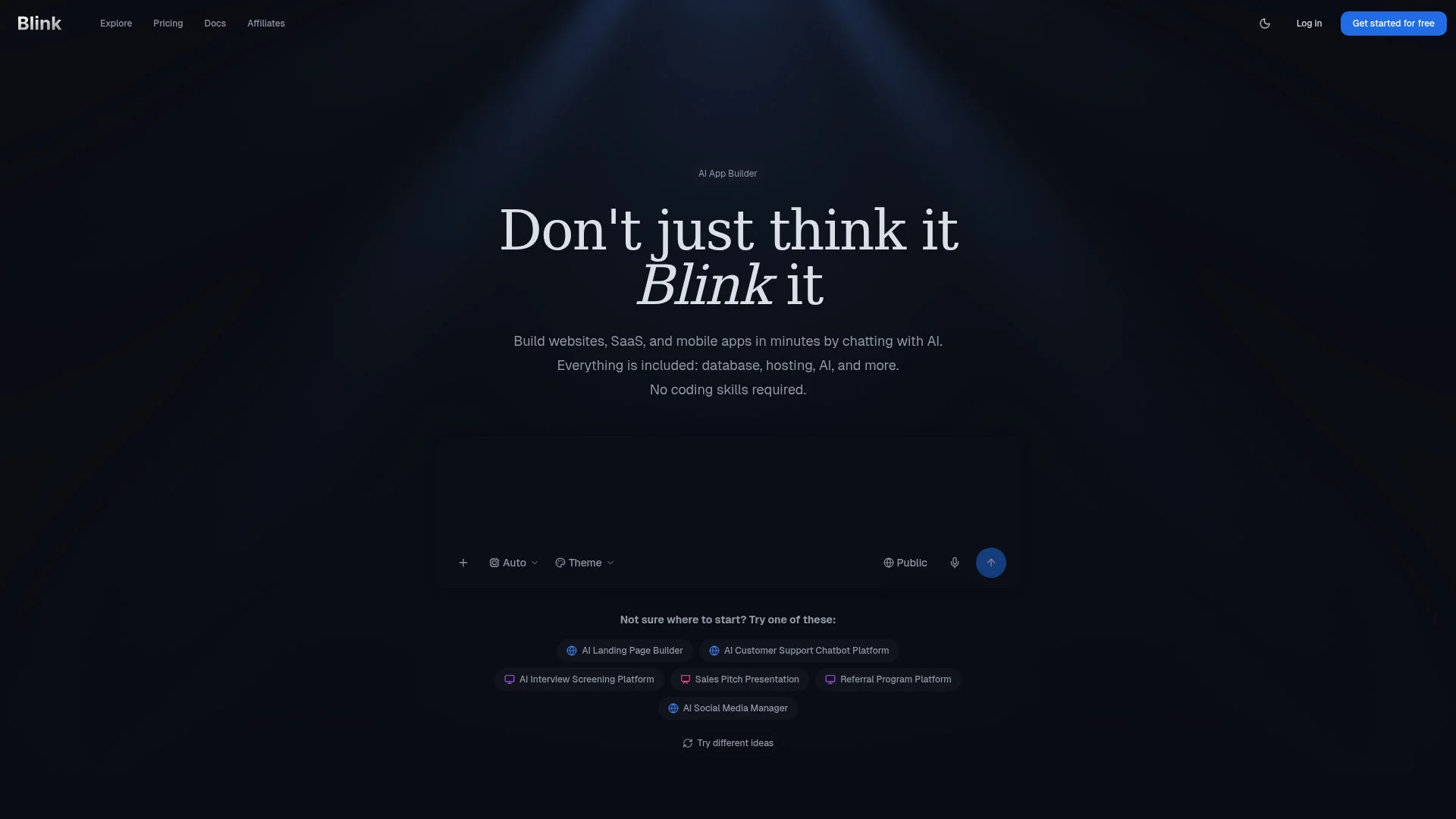
About Blink
Advertiser Disclosure: Futurepedia.io is committed to rigorous editorial standards to provide our users with accurate and helpful content. To keep our site free, we may receive compensation when you click some links on our site.
Key Features
- AI “vibe coding” builder: Users chat with an AI agent that interprets requirements, generates React + TypeScript + PostgreSQL code, and iterates on design and logic based on follow‑up instructions.
- Multimodal AI models: Direct access to models like GPT‑5, Gemini 2.5, Whisper, and proprietary models for text generation, image creation, and text‑to‑speech, all wired into the apps it builds.
- Data APIs and web scraping: Native endpoints for scraping sites, capturing screenshots, and extracting structured content from URLs, useful for dashboards, research tools, and automations.
- Code ownership and export: Paid tiers allow downloading the full source code, editing it, deploying elsewhere, or extending it with custom logic while still benefiting from Blink’s AI builder.
Pros & Cons
Pros
- Huge speed gains: Users routinely report going from idea to working MVP in a single evening, sometimes in under 30 minutes, for apps that would usually take weeks.
- Truly end‑to‑end: Database, backend, frontend, and hosting live in one place, which cuts out a lot of integration and DevOps overhead.
- Friendly for non‑coders, useful for engineers: Non‑technical users can describe outcomes in plain language, while developers can inspect and refine the generated code.
- Production‑oriented stack: Modern technologies like React, TypeScript, and PostgreSQL make the output maintainable for teams who might later bring development in‑house.
- Strong UI quality: Compared to many AI builders, users often highlight that layouts, styling, and UX feel more “ready for customers” out of the box.
- Good for experimentation: Cheap, fast iterations make it practical to test multiple product ideas, pitches, or internal tools without committing a dev team.
Cons
- Credit‑based model: Heavy experimentation or very large apps can consume AI credits quickly, so teams need to keep an eye on usage.
- Complex edge cases still need engineers: Highly specialized logic, deep integrations, or strict performance constraints may require manual coding beyond what the AI agent comfortably covers.
- You are betting on a young platform: The ecosystem is newer than long‑standing no‑code tools, so documentation depth and community plugins are still evolving.