About DetectGPT
Advertiser Disclosure: Futurepedia.io is committed to rigorous editorial standards to provide our users with accurate and helpful content. To keep our site free, we may receive compensation when you click some links on our site.
Key Features
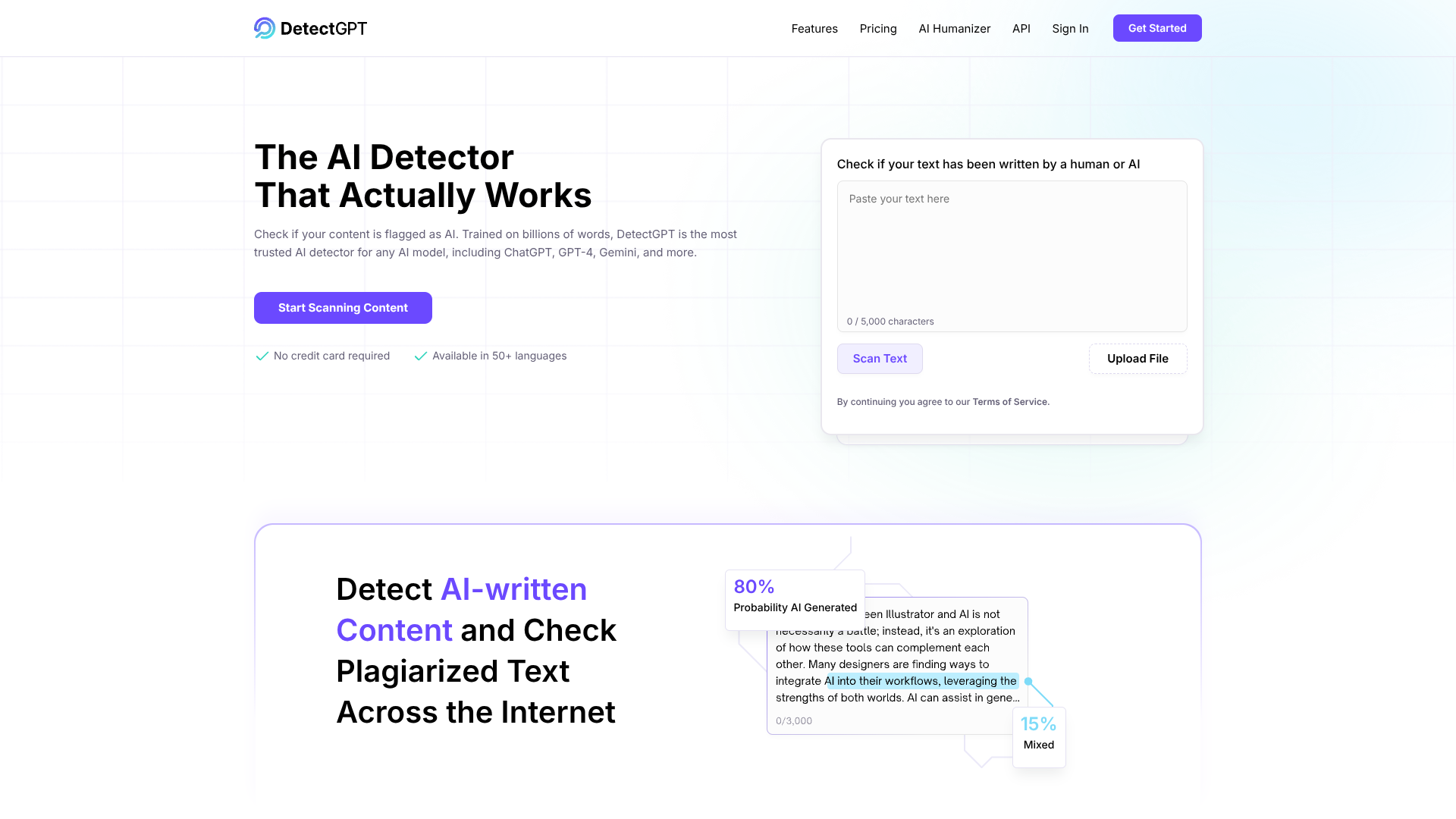
- AI Text Detection Across Models: Classifies text as human, AI, or mixed and provides probability scores, trained on billions of words and tuned for modern models like GPT‑4 and Gemini.
- Original Content Certification: Issues human‑written certificates and shareable analysis links so agencies, freelancers, and publishers can prove authorship to clients and stakeholders.
- Plagiarism, Fact Check, and Readability: Built‑in plagiarism checks against online sources, basic fact verification, and readability scoring to strengthen the integrity and clarity of each piece.
- AI Content Humanizer: Rewrites AI‑generated text to preserve meaning while altering style and structure, aiming to bypass AI detectors, including its own.
- Multi‑Language Support: Works in 50+ languages, helpful for global classrooms and international content teams.
- File and Batch Processing: Upload documents and run batch scans (with quotas based on plan) plus export PDF reports for audit trails and compliance.
- AI Detection & Humanization API: REST API to embed detection and humanization directly into custom platforms, LMSs, or internal tooling.
Pros & Cons
Pros
- Strong Detection Pedigree: Built on research about model log‑probability curvature, giving it a more technical foundation than many “black box” detectors.
- End‑to‑End Content Workflow: Covers detection, plagiarism scanning, readability, and certification in one place instead of stitching together several tools.
- High Volume Friendly: Generous word limits and batch processing suit agencies, universities, and content teams handling lots of documents.
- API for Developers: Easy integration into existing workflows, portals, or moderation pipelines.
- Language Coverage: 50+ languages makes it useful well beyond English‑only environments.
Cons
- Potential for Misuse: The AI humanizer explicitly aims to bypass detectors, which raises ethical and policy concerns in education and hiring.
- Detection Is Not Perfect: Vendor claims of 95–99% accuracy should be treated as indicative, not absolute, especially on short or heavily edited text.
- Limited Transparency on Data Handling: Public materials do not deeply detail how long uploaded content is stored or how it is secured, which larger enterprises may question.