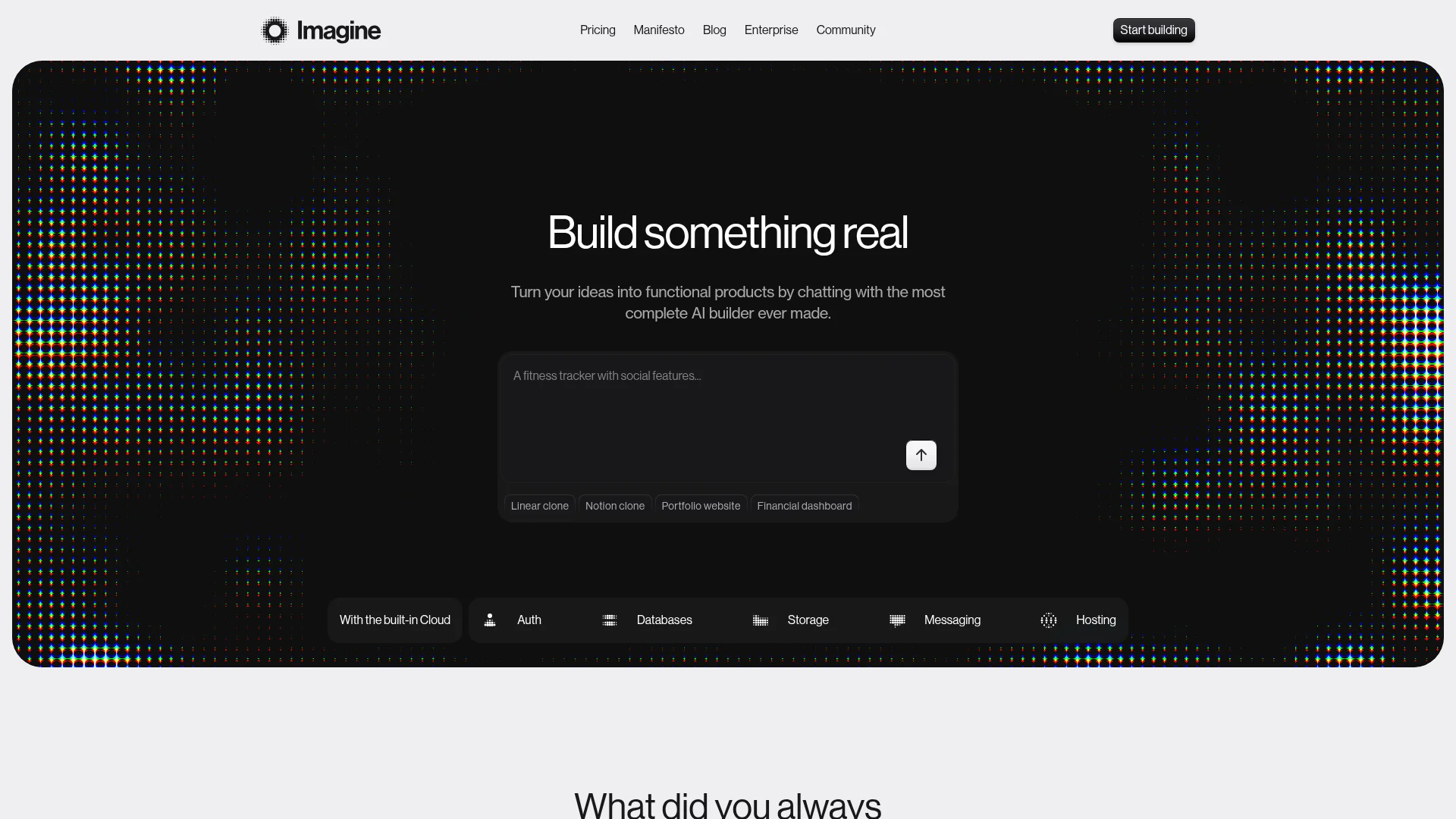
About Imagine
Advertiser Disclosure: Futurepedia.io is committed to rigorous editorial standards to provide our users with accurate and helpful content. To keep our site free, we may receive compensation when you click some links on our site.
Key Features
- Conversational product builder: Chat with an AI agent to define features, flows, and data, then regenerate or refine screens and logic in context.
- Full-stack on Appwrite Cloud: Auth, databases, storage, and hosting are provisioned automatically, so generated apps run on real cloud primitives from day one.
- Production-focused AI architecture: An agent system using Anthropic models targets clean, maintainable code that follows common engineering patterns and best practices.
- Security and compliance baked in: Encryption, DDoS protection, and support for GDPR, SOC 2, HIPAA, and CCPA help teams meet stricter requirements without extra tooling.
Pros & Cons
Pros
- Ships working products quickly: Generates both frontend and backend, so users can reach a usable deployed app in hours, not weeks.
- Approachable for non-developers: Natural language prompts reduce the need for deep coding skills, while developers can still review and extend code.
- Single platform instead of a tool chain: Replaces the usual mix of code generator, backend as a service, and hosting provider with one coherent system.
- Serious security posture for small teams: Built-in protections and compliance features bring enterprise-style safeguards to side projects and early-stage startups.
Cons
- No code export yet: Users cannot take the generated code to another host, which creates platform dependence.
- Some features still “coming soon”: Notifications and realtime sync are advertised but not fully available, limiting certain collaboration-heavy apps.
- Credit limits on free tier: Five credits per day can feel restrictive for heavy experimentation with larger projects.