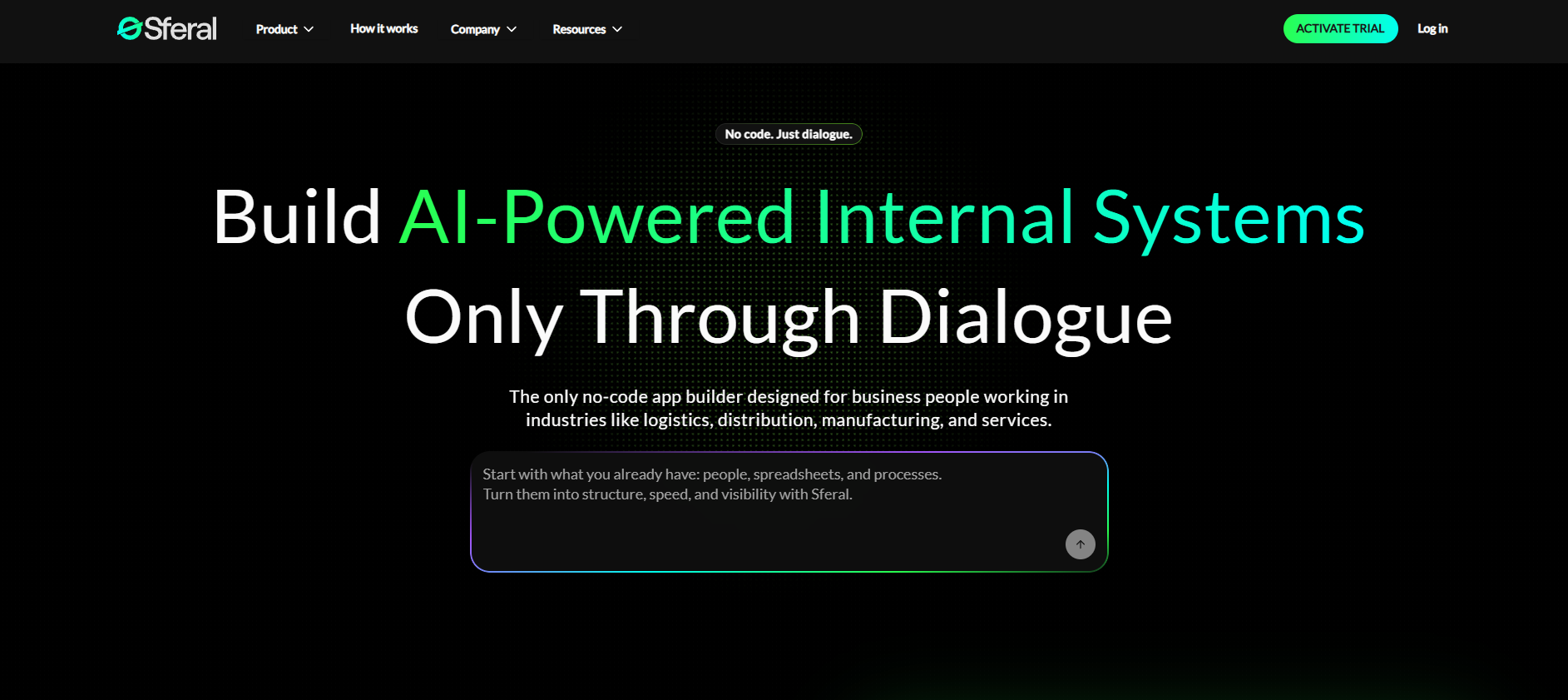
About Sferal
Advertiser Disclosure: Futurepedia.io is committed to rigorous editorial standards to provide our users with accurate and helpful content. To keep our site free, we may receive compensation when you click some links on our site.
Key Features
- Multi-LLM orchestration: Sferal routes tasks across multiple large language models, picking the most suitable model for each job, which helps balance quality, speed, and cost.
- Integrated front-end, back-end, and database: Every app includes the UI, backend logic, secure APIs, and structured data storage by default, plus debugging tools and automated security checks.
- Connectors and data ingestion: Integrates with CRMs, ERPs, HR and finance tools, and ingests PDFs, emails, and spreadsheets so agents operate on current business data instead of isolated exports.
- Governance and observability: A central console shows all agents and workflows, their usage, spend, and ROI, giving leadership the control tower they usually miss in DIY automation efforts.
Pros & Cons
Pros
- Business-user first design: Built explicitly for operations, logistics, and service teams that do not have product managers or dedicated developers.
- Plain-language build process: Non-technical staff can talk through what they want and let the AI propose data models and interfaces, which feels far closer to a working conversation than to a traditional app builder.
- From quick wins to complex workflows: Organizations can start with a single high-impact agent, then expand into cross-department workflows without switching platforms.
- Security and governance built in: Dedicated environments, granular access control, and auditability support companies that care deeply about compliance and risk.
- Proof points and industry focus: Case studies in logistics and manufacturing show clear savings in time, headcount, and SLA penalties, which helps justify investment.
Cons
- Opaque public pricing: There is no detailed pricing grid with usage limits, so most teams need to talk to sales or use the ROI calculator to estimate spend.
- Best fit for mid-sized and larger organizations: Very small teams may find the orchestration, governance, and deployment options more than they practically need.
- Learning curve for process design: Coding is removed, but teams still must articulate workflows, decisions, and data clearly, which can require internal process work.