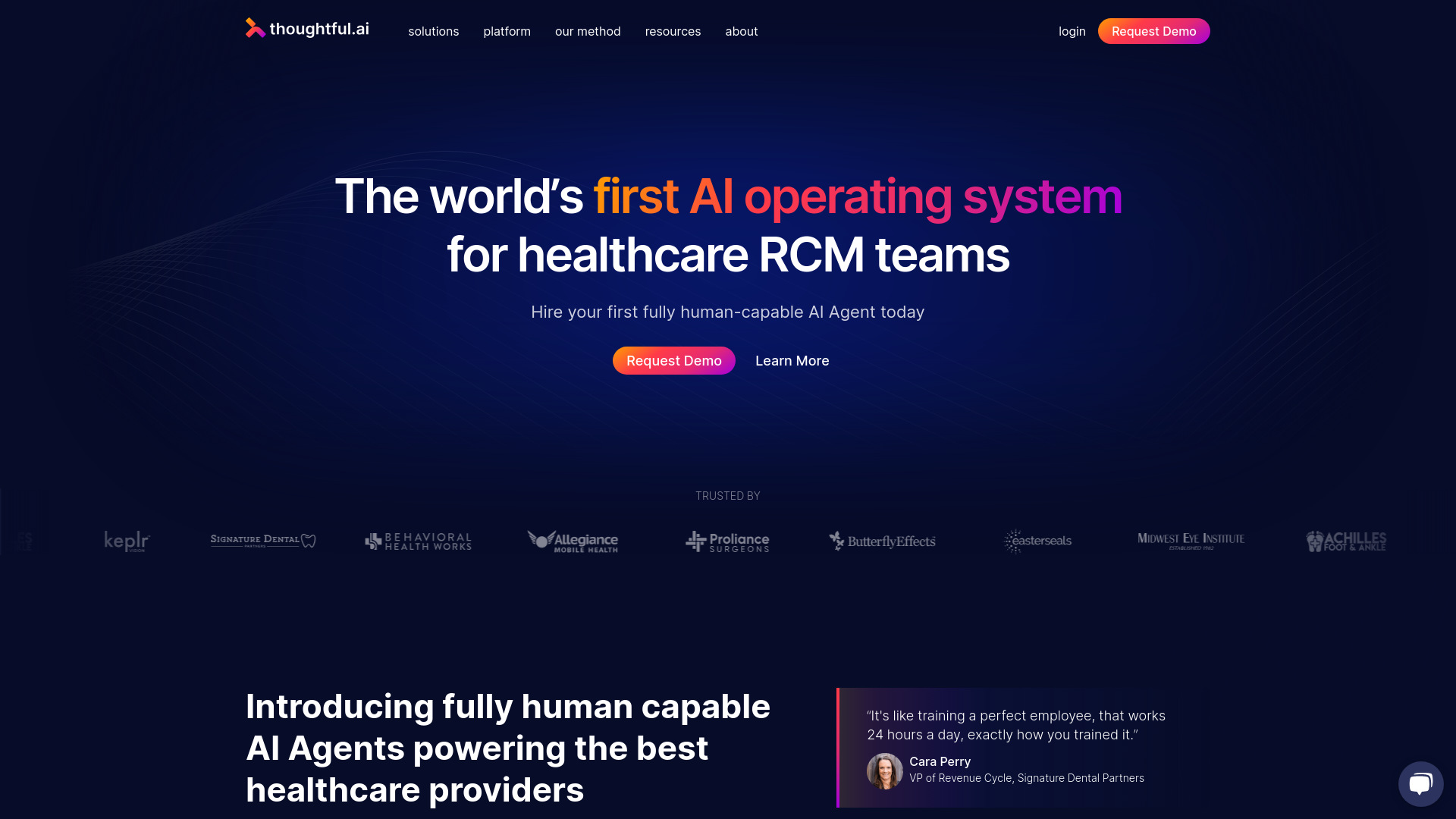
About Thoughtful AI
Advertiser Disclosure: Futurepedia.io is committed to rigorous editorial standards to provide our users with accurate and helpful content. To keep our site free, we may receive compensation when you click some links on our site.
Key Features
- AI-Powered Revenue Cycle Automation: Automates various RCM tasks including eligibility verification, patient intake, claims processing, and more, leading to faster and more accurate operations.
- Custom AI Agents: Deploys AI agents that handle tasks with high efficiency, operating continuously without the need for breaks.
- Enterprise-Wide Integration: Integrates seamlessly across all departments of a healthcare organization, ensuring comprehensive benefits from AI-driven efficiency.
- Performance-Based Contracting: Features a pricing model based on tangible benefits and improvements, ensuring clients only pay for the value they receive.
- Extensive Compatibility: Supports integration with a wide range of healthcare applications, both cloud-based and on-premise, facilitating smooth workflow transitions.
Pros & Cons
Pros
- Increased Efficiency: Automates routine tasks, potentially reducing administrative process time by up to 95%.
- Cost Reduction: Lowers operating expenses by minimizing manual labor and reducing error rates.
- Scalability: Scales easily across multiple departments and processes, supporting organizational growth without additional resources.
- Enhanced Accuracy: Improves billing and coding accuracy, leading to reduced claim denials and lower days sales outstanding (DSO).
Cons
- Complex Integration: Initial setup and integration may be complex and require specialized knowledge.
- Learning Curve: New users may need time to fully understand and utilize all features.
- Technology Dependence: Heavy reliance on AI might reduce personal interaction, which is often crucial in healthcare settings.